
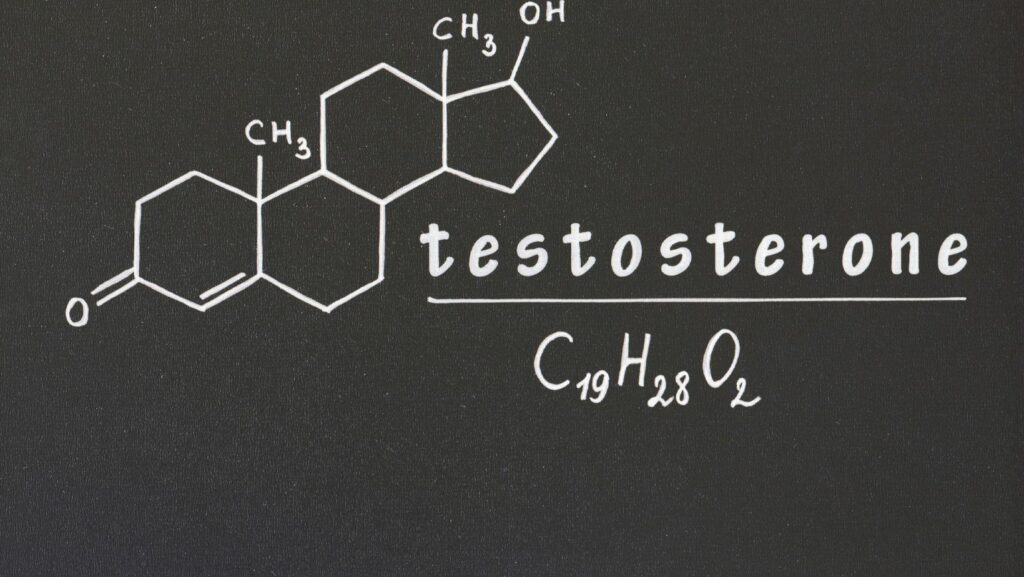
At first glance, boldenone and testosterone look unusually similar. Chemically, boldenone differs from testosterone by only one additional double bond in its steroid structure. That small change is enough to alter how the compound behaves, how long certain preparations remain active, and, more importantly, how much reliable human medical evidence exists behind it.
That last distinction matters most.
The Boldenone vs Testosterone comparison is often reduced to bodybuilding claims about muscle gain, water retention, appetite, or appearance. Medically, the comparison is much less balanced. Testosterone is a natural human hormone with established clinical uses and approved pharmaceutical formulations. Boldenone is an anabolic androgenic steroid developed primarily for veterinary medicine and is not approved for human use in the United States.
Understanding that difference makes it easier to separate pharmacology from gym folklore.
Boldenone vs Testosterone – What Are They?
Testosterone is the principal endogenous androgen in men, although women also produce smaller amounts. It affects sexual development, reproductive function, bone mass, red blood cell production, muscle tissue, mood and numerous other physiological processes.
The body regulates testosterone through the hypothalamic-pituitary-gonadal axis. In simplified terms, the brain signals the testes to produce testosterone, circulating hormone levels feed back to the brain, and production adjusts accordingly.
Medical testosterone products are used when a clinician establishes an appropriate diagnosis of hypogonadism. Current Endocrine Society guidance emphasizes that diagnosis requires both compatible symptoms and consistently low testosterone concentrations rather than symptoms alone.
Boldenone is different.
It is a synthetic anabolic androgenic steroid structurally related to testosterone. Chemically, it contains an additional double bond between carbon 1 and carbon 2. Boldenone undecylenate is the form most widely associated with veterinary use. PubChem describes boldenone as an anabolic steroid developed for veterinary medicine and notes that it is not indicated for human use in the United States.
That distinction should frame every Boldenone vs Testosterone discussion.
One is an endogenous human hormone that can also be prescribed as medicine. The other is a related synthetic anabolic steroid without the same established human therapeutic role.
How Similar Are Boldenone and Testosterone?
Both belong to the anabolic androgenic steroid family.
Both interact with androgen receptors. Activation of these receptors changes gene transcription in androgen-sensitive tissues and contributes to effects on muscle, sexual tissues and other organs.
This shared mechanism explains why the two compounds are frequently discussed together.
It does not make them interchangeable.
Small structural changes in steroid hormones can alter metabolism, receptor activity, conversion into other hormones and the duration of action of esterified preparations.
Boldenone is often described as a testosterone derivative because its basic steroid structure is closely related to testosterone. Yet the evidence available for each substance could hardly be more different.
Testosterone has decades of clinical research in humans.
Much of the published boldenone literature concerns animals, veterinary medicine, doping detection or case reports involving non-medical anabolic steroid use. That makes strong claims about its effects in humans difficult to justify.
This is where many online Boldenone vs Testosterone comparisons go wrong. They present bodybuilding experience as though it carries the same evidentiary weight as controlled human trials.
It does not.
Boldenone vs Testosterone for Muscle Growth
Both substances have anabolic activity, meaning androgen receptor activation can promote processes associated with muscle protein accretion.
That fact alone does not tell us which compound produces a specific amount of muscle growth in humans.
Testosterone has been studied extensively in humans across medical and experimental settings. Its effects on body composition depend on baseline hormone status, exposure, age, training, nutrition and other factors.
Boldenone has nowhere near the same body of controlled human evidence.
Reviews of anabolic steroids describe boldenone as having anabolic and androgenic activity, but much of the experimental research comes from animal models or veterinary applications.
This makes precise internet claims such as one compound producing cleaner gains, slower gains or a specific ratio of anabolic effect scientifically shaky.
Those phrases may circulate widely in bodybuilding communities.
They are not substitutes for human clinical evidence.
For someone comparing Boldenone vs Testosterone for muscle growth, the most defensible conclusion is therefore not a numerical ranking. Testosterone’s effects in humans are much better characterized, while boldenone carries substantially greater uncertainty because controlled human data are limited.
Testosterone Has a Medical Role That Boldenone Does Not
This is probably the most important practical difference.
Testosterone replacement therapy has recognized medical applications when a patient has an appropriately diagnosed testosterone deficiency associated with a medical condition. Approved formulations include injections, gels and other delivery methods.
That does not mean testosterone is harmless.
Prescription testosterone requires diagnosis, selection of appropriate patients and ongoing monitoring. The Endocrine Society recommends against initiating therapy in several situations, including certain men with elevated hematocrit, untreated severe obstructive sleep apnea, recent myocardial infarction or stroke, thrombophilia, or plans for fertility in the near term.
Boldenone does not occupy an equivalent place in contemporary human medicine.
The Endocrine Society’s scientific statement on performance-enhancing drugs specifically describes boldenone as a veterinary steroid not approved for human use.
So a Boldenone vs Testosterone comparison cannot reasonably treat the two as alternative forms of hormone replacement therapy.
They are not.
What Happens to Natural Testosterone Production?
External anabolic androgens can disrupt the body’s own hormone regulation.
When androgen levels rise because of an external steroid, the hypothalamus and pituitary can reduce the signals that normally stimulate the testes. This can suppress endogenous testosterone production and sperm production.
That effect matters for fertility.
Medical guidance specifically warns against testosterone therapy in men planning fertility in the near term because external testosterone can suppress spermatogenesis.
Boldenone is not exempt from this problem simply because it is a different anabolic steroid.
Animal research has documented suppression of reproductive parameters after boldenone exposure. A rabbit study, for example, reported lower serum testosterone, reduced sperm count and motility, and changes in testicular tissue. Animal results cannot be translated directly into exact human outcomes, but they reinforce the fact that boldenone is not hormonally neutral.
This is one area where the Boldenone vs Testosterone argument often becomes misleading.
Replacing testosterone with another anabolic androgen does not preserve normal endocrine function.
The body still recognizes strong androgenic signaling.
Boldenone, Testosterone and Red Blood Cells
Androgens can stimulate red blood cell production.
In a medical context, this is one reason hematocrit is monitored during testosterone therapy. Excessive erythrocytosis can make treatment unsafe, and clinical guidance has historically used hematocrit as an important treatment-limiting measurement.
That monitoring is not an administrative detail.
Elevated hematocrit means a greater proportion of blood volume consists of red blood cells. As the value rises, clinicians become concerned about the potential consequences of excessive erythrocytosis.
Boldenone is also associated with stimulation of erythropoiesis as part of its anabolic activity. Published descriptions of anabolic steroids include increased red blood cell production among their physiological effects.
Comparing the precise magnitude of this effect between boldenone and testosterone in bodybuilding conditions is difficult because reliable head-to-head human trials do not exist.
That uncertainty matters.
A lack of controlled evidence should not be interpreted as evidence of lower risk.
What About Estrogen?
Testosterone can be converted into estradiol through the aromatase enzyme.
Estradiol is not merely an unwanted by-product. In men it contributes to bone health, sexual function and other physiological processes.
Problems can occur when hormone levels move outside normal physiological ranges, but the relationship is much more complicated than the common idea that estrogen should always be minimized.
Boldenone is frequently discussed online as having different estrogen-related effects from testosterone.
The problem is the quality of the evidence.
There is much less controlled human research defining boldenone’s estrogenic behavior, its metabolites and the clinical consequences of non-medical exposure. Statements assigning exact percentages of aromatization or predicting a specific estrogen response should therefore be treated cautiously unless supported by appropriate human pharmacological data.
This is another reason Boldenone vs Testosterone should not be reduced to bodybuilding shorthand.
Biochemistry is more complicated than high or low estrogen.
Androgenic Effects Are Possible With Both
The term androgenic refers to effects associated with androgen receptor signaling outside the desired increase in muscle tissue.
These can include changes in skin oil production, acne, hair growth patterns and androgen-sensitive hair loss in genetically susceptible people.
Testosterone can also be converted by 5-alpha-reductase into dihydrotestosterone in certain tissues.
Boldenone has androgenic activity as well. PubChem classifies it as an anabolic androgenic steroid that acts through androgen receptors.
The real-world response varies considerably between individuals.
Genetics, baseline hormone levels, age, duration of exposure and the presence of other substances all change the outcome.
A simple statement that one compound is androgenic while another is not would therefore be inaccurate.
Both are androgenic steroids.
Boldenone vs Testosterone in Competitive Sport
For tested athletes, the distinction becomes straightforward.
Anabolic agents are prohibited under World Anti-Doping Agency rules. Boldenone is specifically listed among prohibited anabolic androgenic steroids, and exogenous testosterone is also prohibited outside permitted medical circumstances governed by anti-doping rules.
Testing technology is designed to identify anabolic steroid use and associated metabolites.
The consequences can extend well beyond health, including disqualification, suspension and damage to an athlete’s career.
Anyone subject to anti-doping rules therefore needs to evaluate medicines through the relevant sporting authority rather than assuming that a prescription automatically makes a substance permissible.
Boldenone vs Testosterone Side Effects
There is considerable overlap because both compounds act on androgen pathways.
Potential concerns associated with anabolic androgen exposure include suppression of natural hormone production, impaired fertility, acne and other androgenic effects, changes in cardiovascular risk factors, increased red blood cell production and psychological effects.
The comparison becomes asymmetric when evidence quality is considered.
With testosterone, clinicians have established diagnostic criteria, pharmaceutical products, monitoring systems and decades of human research.
With boldenone, there is no comparable evidence base for routine human treatment.
That does not make prescription testosterone risk-free. It means its risks are better characterized.
The distinction is important.
Known risk can be monitored.
Poorly characterized risk is harder to manage.
Boldenone vs Testosterone: The Main Difference Is Bigger Than Muscle Gain
The superficial Boldenone vs Testosterone comparison focuses on physique.
The medically important comparison focuses on evidence, approval and risk.
Testosterone is a hormone naturally produced by the human body and also a prescription medicine with legitimate indications. Clinicians know how to diagnose testosterone deficiency, when treatment may be appropriate and which measurements require monitoring.
Boldenone is a related synthetic anabolic steroid developed primarily for veterinary use. It has been used illicitly for performance enhancement, but this does not give it the same medical status or evidence base as testosterone.
Both can affect endocrine function.
Both can produce androgenic effects.
Both can influence red blood cell production.
And non-medical anabolic steroid use can expose users to cardiovascular, reproductive and other health risks.
The most useful conclusion from Boldenone vs Testosterone is therefore not that one is the stronger or cleaner option. It is that testosterone and boldenone occupy fundamentally different positions in human medicine, and the uncertainty surrounding boldenone is itself part of its risk profile.
Anyone considering testosterone because of symptoms such as low libido, fatigue or reduced sexual function should start with proper medical evaluation rather than assuming the symptoms prove testosterone deficiency. Current endocrine recommendations require compatible symptoms plus consistently low laboratory measurements before diagnosing hypogonadism.
That distinction is worth revisiting whenever a Boldenone vs Testosterone discussion turns a medical question into a simple steroid ranking. More information: https://supplements4muscle.com/en/module/blockblog/blog?post_id=363